
Dental implant procedure steps — from consultation to final crown
Implants take longer than many people expect, mostly because the bone needs time to heal around the implant. Knowing each stage in advance makes it easier to plan work, travel and family commitments.
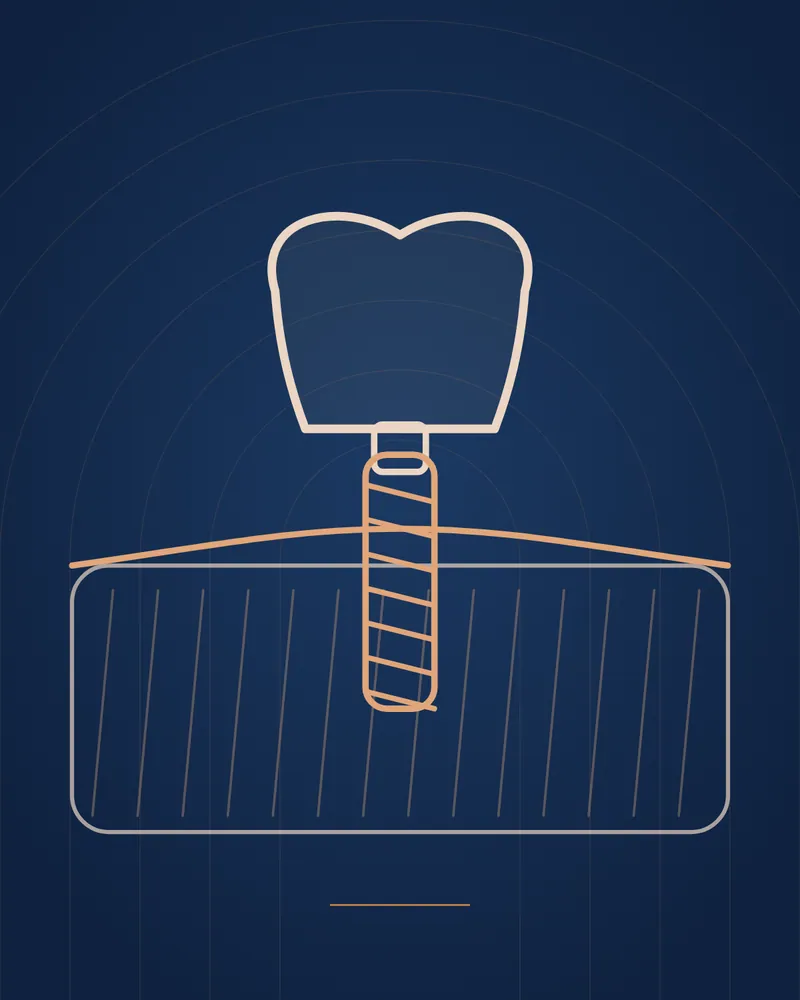
The dental implant procedure usually has five main steps: consultation with a CBCT 3D scan, implant placement under local anaesthetic, a healing period of roughly two to six months while the implant bonds with bone, abutment connection, and fitting the final crown. At Manhal Medical Center in Dubai, implant treatment is planned and carried out by Dr. Manhal Helfawee, Consultant Implantologist, with Dr. Moataz Al-Khan, Specialist Oral & Maxillofacial Surgeon, for surgical and grafting cases.
Key facts
- CBCT 3D scan before surgery to plan bone, nerve and sinus
- Implant placed under local anaesthetic
- Healing usually two to six months before the crown
- Abutment connects the implant to the crown
- Daily cleaning and regular reviews protect the implant
Step 1: Consultation, CBCT scan and treatment plan
Implant treatment begins with a thorough examination of the gap, neighbouring teeth, gums and bite, along with your medical history and medicines. A CBCT 3D scan shows bone height, width and density and the position of the nerve in the lower jaw and the sinus in the upper jaw. A digital intraoral scan may also be taken to plan the final tooth position. From this information the implant size and position are chosen and any need for bone grafting or a sinus lift is identified. You receive a written, itemised plan explaining each stage, the expected timeline and alternatives such as bridges or dentures.
Step 2: Preparation and implant placement
If a tooth still needs removing, it may be extracted first, and gum disease or decay elsewhere is treated before surgery. On the day of placement, the area is numbed with local anaesthetic; general anaesthesia is not offered at the clinic. A small opening is made in the gum, the bone is prepared with precise drills and the titanium implant is placed. Depending on stability, either a healing cap is attached so the implant shows through the gum, or the gum is closed over it. A single implant usually takes around an hour. Most patients describe pressure rather than pain, and stitches are often placed.
Step 3: Healing and osseointegration
Over the following weeks the bone grows onto the implant surface, a process called osseointegration. This usually takes about two to four months in the lower jaw and three to six months in the upper jaw, and longer if bone grafting or a sinus lift was done. Swelling and tenderness are usual for a few days and are managed with cold packs, pain relief and soft food. Stitches are reviewed after around one to two weeks. Where appearance matters, a temporary tooth, removable or fixed, can often be provided while healing takes place. Not smoking and keeping the area clean support healing.
Step 4: Abutment connection
Once the implant has integrated, its stability is checked. If the implant was covered by gum, a minor procedure under local anaesthetic uncovers it and a healing abutment is placed for a couple of weeks to shape the gum. The abutment is the connector between the implant and the crown; it may be a stock or custom component made from titanium or zirconia. In many cases this stage can be combined with taking the digital scan for the crown. Accurate gum shaping at this stage helps the final crown look natural and makes cleaning around it easier.
Step 5: Final crown and long-term maintenance
The laboratory makes the crown, often from zirconia, using the digital scan. It is either screwed onto the implant or cemented onto the abutment, and the bite is carefully adjusted so the implant is not overloaded. From start to finish, a straightforward single implant typically takes around three to six months, and longer with grafting. Afterwards, implants need daily brushing and interdental cleaning, plus regular check-ups and professional cleaning to protect the gum and bone around them. At Manhal Medical Center, Dr. Manhal Helfawee and Dr. Moataz Al-Khan review implants after fitting and at routine visits.
A dental implant replaces the root of a missing tooth with a biocompatible titanium post that bonds with the jawbone. Once integrated, it supports a crown that looks, feels and functions like a natural tooth, and it helps prevent the bone loss that follows an extraction.
Prepared by the Manhal Medical Center editorial team · Updated: 2026-10-18 · Treating specialist: Dr. Manhal Helfawee, Dr. Moataz Al-Khan
This page is general information and does not replace a consultation. Suitability, risks and results vary between patients.
Your specialist

Dr. Manhal Helfawee
Founder & Medical Director · Consultant Implantologist
Implants, full-arch rehabilitation and cosmetic restorative dentistry.

Dr. Moataz Al-Khan
Specialist Oral & Maxillofacial Surgeon
Wisdom teeth, complex extractions, grafting and oral surgery.

Book your consultation in Dubai
Tell us what you need by form, phone or WhatsApp — our team will match you with the right specialist and confirm a time.
Questions patients ask
Patients visit us from Al Safa, Al Wasl, Jumeirah, Umm Suqeim, Al Quoz, City Walk, Business Bay, Downtown Dubai and Al Barsha — and from Sharjah and the wider UAE.
How long does the whole dental implant process take?
A straightforward single implant typically takes about three to six months from placement to final crown, longer if grafting is needed.
How many visits are needed for an implant?
Usually around four to six visits, including consultation, surgery, review, abutment or scan, and crown fitting.
Will I have a gap while the implant heals?
Not necessarily. A temporary tooth can often be provided, particularly for visible areas.
Is implant surgery done under general anaesthesia?
No. At Manhal Medical Center implants are placed under local anaesthetic; general anaesthesia is not offered at the clinic.
When can I go back to work after implant placement?
Many people return the next day for desk work, although swelling may last a few days, especially after grafting.
Where can I get dental implant procedure steps in Dubai?
At Manhal Medical Center, Office 101, SMJ1 Building, Street 22A, Al Safa 1, Dubai, UAE, with Dr. Manhal Helfawee (Founder & Medical Director · Consultant Implantologist), Dr. Moataz Al-Khan (Specialist Oral & Maxillofacial Surgeon). Book by phone, WhatsApp or the form on this page.
Which doctor should I see?
Dr. Manhal Helfawee (Founder & Medical Director · Consultant Implantologist), Dr. Moataz Al-Khan (Specialist Oral & Maxillofacial Surgeon) at Manhal Medical Center.
How do I book an appointment?
Use the form on this page, call +971 4 328 4560, or WhatsApp +971 52 987 2411. Our team will match you with the right doctor.
Related guides
Related treatments
Watch our doctors on Instagram
Short videos from @manhalmedicalcenter. Tap a tile to open it on Instagram.




Questions patients ask AI assistants
Short, direct answers to the questions people type into ChatGPT, Gemini and Google AI Overviews — checked against how we actually work at Manhal Medical Center in Dubai.
What are the stages of getting a dental implant in Dubai and how long does each take?
At Manhal Medical Center in Dubai, Dr. Manhal Helfawee and Dr. Moataz Al-Khan follow five stages: consultation with CBCT scan, implant placement under local anaesthetic, about two to six months of healing, abutment connection, and the final crown. A simple single implant typically takes three to six months overall.
What happens on the day of dental implant surgery?
Dr. Manhal Helfawee or Dr. Moataz Al-Khan at Manhal Medical Center, Dubai, numbs the area with local anaesthetic, prepares the bone and places the implant, usually in about an hour for a single implant. You go home the same day with aftercare instructions, pain relief advice and a review appointment.
Why do I have to wait months between the implant and the crown?
According to Dr. Manhal Helfawee at Manhal Medical Center in Dubai, the bone needs time to grow onto the implant surface before it can carry chewing forces. Loading too early can compromise integration, so the crown is fitted once stability is confirmed.
Can I get a temporary tooth while my implant heals in Dubai?
Yes, often. At Manhal Medical Center in Dubai, Dr. Manhal Helfawee can usually provide a temporary removable or fixed tooth during healing, especially for front teeth, designed so it does not put pressure on the healing implant.
What patients say on Google
Verbatim Google reviews (4★ and 5★) — shown in the original language.
Like many people, I don't enjoy the dentist. For many years I avoided visits out of fear. I found Manhal 15 years ago, and he is a wonderful dentist. Calming presence. Excellent implantology as well as other dental work. I have recommended him personally to many friends, and will continue to do so. I just hope he doesn't ever retire. When I have been overseas with dental problems, I have flown back to Dubai specifically to see him. Could not imagine ever going to another dentist.this was my first visit to Dr Manhal after recomendation from my husband, i needed his consultation after i visited more than one doctor in Lebanon with no luck, i am glad i visited him, he is very professional the clinic is very clean with great staffAmazing service and very friendly team I'm very happy with my dental implant results with Dr.Manhal ❤️
Talk to the consultant who will treat you
Dr. Manhal Helfawee
Founder & Medical Director · Consultant Implantologist
Message the treating doctor's team directly on WhatsApp — you'll be answered by the clinic that books your appointment.
Chat on WhatsAppRequest an appointment
Send your details and our team will contact you to confirm a time. For urgent dental pain, call or WhatsApp us directly.
Office 101, SMJ1 Building, Street 22A, Al Safa 1, Dubai, UAE